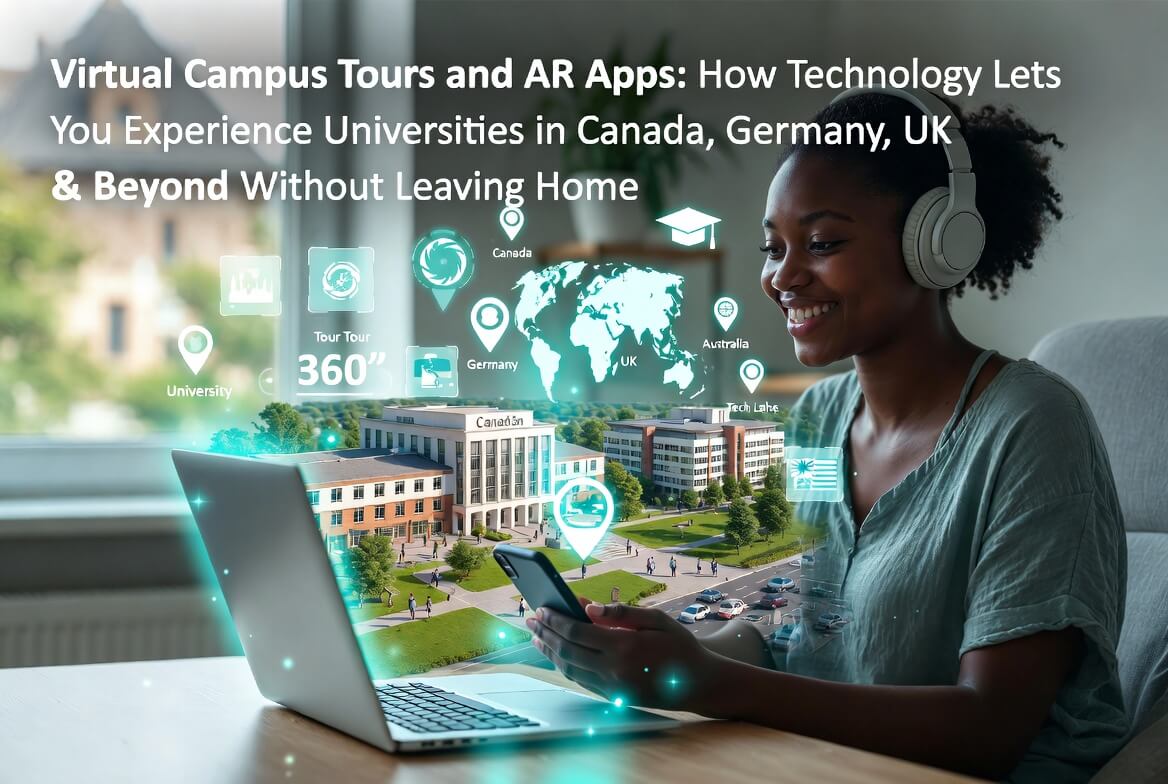
Applying to universities abroad used to mean expensive flights, costly accommodation, and weeks of travel just to walk around a campus for a few hours. In 2026, that barrier has almost disappeared. Thanks to advanced virtual campus tours and augmented reality (AR) apps, you can now explore lecture halls, libraries, student residences, research labs, and even the surrounding city — all from your room in Ibadan, Lagos, Mumbai, Manila, or anywhere else in the world.
These immersive tools are especially valuable for students researching STEM programs. They help you visualize daily life on campus, understand the facilities available for your field (AI labs, cybersecurity simulation rooms, engineering workshops), and decide whether a university truly feels like the right fit before you commit time and money to an application.
In this detailed guide, we explore the best virtual campus tour platforms and AR apps available in 2026, how they make choosing a university abroad easier, and why they are becoming essential for anyone planning to study, work, and potentially relocate through education.
Why Virtual Tours and AR Matter for International Students
A physical campus visit gives you a “feel” for the place that photos and videos can’t capture. You notice the energy of the student community, the quality of labs, the distance to accommodation, and the overall atmosphere. Virtual tours and AR now deliver a very close version of that experience — often with added benefits:
- You can visit multiple universities in different countries in a single afternoon.
- You explore at your own pace, zooming into specific facilities relevant to your STEM field.
- Many tours include real student testimonials, 360° views, and interactive elements.
- AR apps let you overlay campus information onto your real-world environment or view 3D models of buildings.
For students targeting countries with strong post-study work visas (Canada’s PGWP, Germany’s 18-month job search visa, UK Graduate Route, Australia’s Temporary Graduate Visa), these tools help you choose universities whose locations, industry connections, and campus resources best support your long-term relocation goals.
Top Virtual Campus Tour Platforms and AR Apps in 2026
1. YouVisit
YouVisit remains one of the most popular and comprehensive platforms for virtual campus tours. It offers high-quality 360° interactive tours for hundreds of universities worldwide, including many top STEM institutions in Canada, the UK, Germany, Australia, and the Netherlands.
You can “walk” through engineering buildings, sit in lecture theatres, explore research labs, and even check out dining halls and sports facilities. Many tours include narrated guides from current students and faculty.
Best for: Detailed, realistic campus exploration with a focus on student life.
2. CampusReel
CampusReel combines user-generated video content with professional virtual tours. Real students film and upload authentic footage of their daily lives on campus — from morning lectures to late-night study sessions in the library.
The platform’s AI helps match you with videos from students in similar programs or from similar backgrounds, making the experience more relatable for international applicants.
Best for: Getting an honest, unfiltered view of campus culture and student experiences.
3. Matterport
Matterport’s 3D scanning technology creates incredibly detailed digital twins of university buildings. You can freely navigate inside labs, classrooms, and residence halls as if you were physically there. Many universities now use Matterport for their official virtual tours.
Best for: Technical fields where seeing the quality of equipment and lab spaces is crucial (e.g., robotics, data centers, AI research facilities).
4. Google Earth VR & Google Campus Tours
Google has significantly improved its virtual campus experiences. Using Google Earth VR (available on compatible headsets) or the standard web version, you can fly over entire university campuses and explore surrounding cities. Some universities have integrated detailed indoor tours as well.
Best for: Understanding the broader location — how close the campus is to tech hubs, public transport, and job opportunities.
5. AR Campus Apps (University-Specific)
Many leading universities now offer their own augmented reality apps. For example:
- University of Toronto and University of British Columbia have AR experiences that let you point your phone at a printed campus map or use GPS to see 3D overlays of buildings and facilities.
- Technical University of Munich (TUM) and other German universities provide AR tours highlighting engineering and computer science labs.
- Imperial College London and University of Melbourne have developed immersive AR experiences for prospective STEM students.
These apps often include interactive elements such as tapping on a building to see current research projects or available courses.
Best for: Deep dives into specific universities you are seriously considering.
6. UniTours and Similar Aggregator Platforms
UniTours and comparable services bring together virtual tours from hundreds of universities in one place. Their AI recommendation engine suggests tours based on your chosen field of study and preferred countries.
Best for: Students who want to compare multiple institutions quickly.
7. Meta Horizon Workrooms & Spatial.io (Emerging VR Options)
For those with access to VR headsets (Meta Quest, Apple Vision Pro, or similar), platforms like Spatial.io and Meta’s tools allow group virtual campus visits. You can “meet” admissions officers or current students in a shared virtual space while exploring the campus together.
Best for: More immersive, social experiences.
8. 360° Video on YouTube & Vimeo
Many universities upload high-quality 360° videos to YouTube. While less interactive than dedicated platforms, they are completely free and accessible on any device. Search for “[University Name] virtual campus tour 2026”.
Best for: Quick, no-commitment previews.
9. Apple ARKit & Google ARCore Powered Apps
Newer apps built on Apple’s ARKit and Google’s ARCore let you place 3D models of university buildings on your table or floor at home. Some even simulate walking through a virtual campus in your living room.
Best for: Fun, hands-on exploration when you want something different.
10. AI-Enhanced Virtual Tour Assistants
Some platforms now integrate conversational AI that answers questions while you tour. Ask “Show me the AI research lab” or “How far is the nearest tech company from this residence?” and the system guides you accordingly.
Best for: Personalized guidance during your virtual visit.
How to Make the Most of Virtual Tours and AR Apps
Follow this practical strategy:
- Start with Your Shortlist — After using AI matching platforms (like those in Topic 1), pick your top 8–10 universities.
- Schedule Dedicated Tour Time — Block 30–60 minutes per university. Use headphones for better immersion.
- Focus on What Matters for STEM — Pay special attention to laboratories, computing facilities, collaboration spaces, and industry partnership buildings.
- Check Location Context — Use Google Earth to see proximity to tech hubs (e.g., Toronto’s tech corridor, Berlin’s startup scene, or Melbourne’s innovation precinct).
- Take Notes and Screenshots — Document what you like and dislike about each campus for later comparison.
- Combine with Other Research — Pair virtual tours with student forums (Reddit, CampusReel videos) and official program pages.
Real Student Experiences in 2026
Many international students report that virtual tours helped them make better decisions. One student from Nigeria who applied to universities in Canada said the Matterport tour of the University of Waterloo’s engineering buildings convinced her that the facilities matched her ambitions in robotics. Another applicant from India used the University of Manchester’s AR app and realized how walkable the campus was — an important factor for daily life.
These tools have reduced “buyer’s remorse” after arrival and helped students choose universities whose environment best supports both academic success and future job prospects.
Limitations to Keep in Mind
Virtual tours cannot fully replace the feeling of being on campus in person. Weather, the energy of real students, and small everyday details may differ. However, for the vast majority of applicants — especially those on tight budgets — these technologies provide more than enough information to make informed choices.
Final Thoughts
In 2026, virtual campus tours and AR apps have democratized access to university exploration. No longer do you need thousands of dollars for multiple international trips. You can now experience top universities in Canada, Germany, the UK, Australia, the Netherlands, and beyond from the comfort of your home.
These tools, combined with the AI-powered matching platforms we discussed previously, form a powerful tech stack that makes planning your study abroad journey smarter, faster, and more realistic.
Ready to start exploring? Open YouVisit or CampusReel today and begin your virtual campus journey. Many students discover their perfect university this way — often one they would never have considered without immersive technology.
Have you tried any virtual campus tours or AR apps yet? Which one impressed you the most, and how did it influence your university choices? Share your experiences in the comments — your insights could help fellow readers planning their own move abroad.
At Tech Falytics, we continue to explore how smart technology removes barriers and opens genuine pathways to studying, working, and building a life in new countries.